Against the backdrop of rapid global advancements in Unmanned Aerial Vehicle (UAV) technologies, autonomous delivery systems, and intelligent coordination networks, the “low-altitude economy” has emerged as a new frontier for digital economic growth. This rising sector encompasses diverse economic activities taking place within lower airspace boundaries, including drone delivery, infrastructure monitoring, smart city operations, emergency rescue, digital agriculture, and automated logistics networks.
Numerous industry experts emphasize that, alongside Artificial Intelligence (AI) and automation, low-altitude logistics is poised to become a critical component of future urban infrastructure and global supply chains. In Vietnam, however, formal higher education dedicated to this discipline remains in its infancy, creating a pressing shortage of highly qualified professionals capable of operating, managing, and orchestring these intelligent logistics frameworks.
Recognizing this market reality, the Posts and Telecommunications Institute of Technology (PTIT) will officially introduce its pioneering undergraduate program in Logistics in the Low-Altitude Economy, open for enrollment starting from the 2026 admissions cycle. This innovative major seamlessly integrates digital technologies, modern logistics, AI, UAV operations, and smart coordination systems to train a new generation of professionals for future operational models.
To provide parents and prospective students with deep-dive insights into this cutting-edge major, the Editorial Board sits down with Dr. Tran Thi Hoa, Head of the Department of Economics at the Faculty of Business Administration 1, to discuss career trajectories, curriculum orientations, and the growth potential of low-altitude logistics.

Photo: Dr. Tran Thi Hoa – Head of the Department of Economics, Faculty of Business Administration 1.
Editorial Board: Dear Dr. Hoa, the “low-altitude economy” remains a relatively novel concept in Vietnam. Could you provide a clear overview of what this sector entails, and explain why PTIT has chosen to launch the Logistics in the Low-Altitude Economy program at this specific juncture?
Dr. Tran Thi Hoa: The “Low-Altitude Economy” refers to economic activities that leverage lower airspace via smart aviation technologies, such as UAVs/drones and autonomous aerial vehicles. Powered by AI, IoT, Big Data, and digital control systems, this ecosystem services various fields, including logistics, transportation, e-commerce, smart cities, high-tech agriculture, and digital monitoring services.
While traditional logistics operates primarily on a two-dimensional ground infrastructure, the global industry is rapidly shifting toward smart, three-dimensional spatial logistics networks. This represents a strategic evolutionary step in the digital economy. Although still emerging in Vietnam, the low-altitude economy is growing exponentially worldwide, serving as a powerful new engine for strategic growth and a core pillar of future smart city development.
As a premier technology-focused higher education institution, PTIT recognizes that the labor market is undergoes profound shifts driven by AI, automation, e-commerce, and digital transformation. Modern enterprises no longer look solely for traditional logistics personnel; they demand a new generation of professionals who comprehend core logistics, command technology, analyze complex data, and manage automated architectures. Currently, professionals possessing this cross-disciplinary blend of logistics expertise and digital execution remain exceptionally scarce in Vietnam.
This is where PTIT leverages its distinct competitive edge. Our leading technological foundation allows us to design an ideal interdisciplinary ecosystem for the “Logistics in the Low-Altitude Economy” program. Students will immerse themselves in an academic environment strong in AI, Big Data, IoT, and digital transformation, backed by state-of-the-art laboratories. Furthermore, PTIT’s expansive industry network with top-tier technology, logistics, and e-commerce corporations offers students unparalleled corporate exposure, internships, and direct access to high-demand careers.
Our program breaks away from traditional boundaries by combining modern logistics administration, AI, IoT, supply chain analytics, UAV systems, and smart operations. Our goal is to train a tech-driven workforce capable of mastering digital tools and thriving in future economic landscapes. We are confident that this program is a vital stepping stone, preparing highly competitive graduates to satisfy the market demands of the next 5 to 10 years.
Editorial Board: Is this curriculum geared more toward logistics management or technical engineering? What specific subjects will students focus on to effectively work alongside UAVs, autonomous mobile robots (AMRs), and smart flight coordination systems?
Dr. Tran Thi Hoa: Logistics in the Low-Altitude Economy is strictly an interdisciplinary program bridging modern logistics management, digital technology, AI, data analytics, and smart operations. It does not lean entirely toward conventional logistics, nor does it train pure technical engineering software developers. Instead, it targets a versatile professional profile: the next-generation logistics specialist who excels at applying technology to optimize digital workflows.
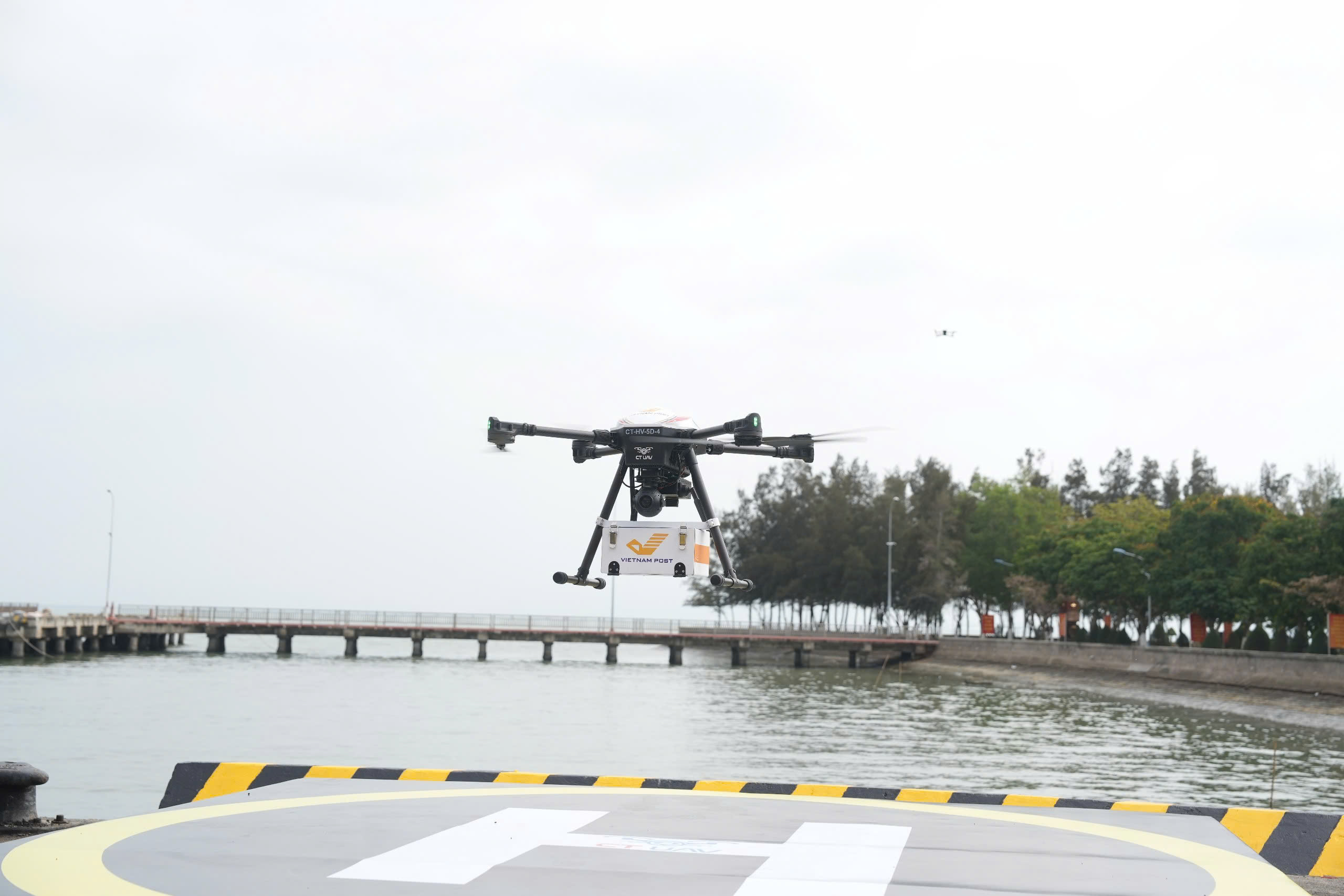
Photo: A UAV taking off at the Can Gio ferry terminal (Image credit: Vietnam Post).
At PTIT, the traditional pillars of transportation, warehousing, and supply chain management are expanded to include advanced modules such as:
-
AI Applications in Logistics
-
Logistics Data Analytics & Digital Logistics
-
IoT & Smart Coordination Systems
-
UAV/Drone Logistics Operations
-
Autonomous Mobile Robots (AMRs) in Smart Warehousing
Our curriculum does not expect students to manufacture drones or program robotics from scratch. Rather, it empowers them to manage, coordinate, and orchestrate these autonomous assets. Students will learn how to deploy drones for delivery and surveillance, optimize routing via AI algorithms, coordinate logistics networks in real-time, and link global supply chains through digital platforms. Additionally, they will cultivate essential soft competencies, including systems thinking, data-driven decision-making, and agility in high-tech environments—critical skills as global logistics transitions from manual processes to data-driven automation.
Editorial Board: Beyond traditional logistics companies, what other industries will open up career opportunities for graduates of this program?
Dr. Tran Thi Hoa: Due to its interdisciplinary design across business administration, digital tech, and automated systems, graduates can transcend traditional sectors to pursue diverse, lucrative pathways within the digital economy.
Potential employers include:
-
Global e-commerce corporations and fast-growing technology firms;
-
Logistics startups and tech-driven delivery operators;
-
Intelligent Operations Centers (IOCs) and smart warehouse facilities;
-
Digital transformation consultancies and smart city management units;
-
Tech-enabled transport networks and supply chain hubs.
As the low-altitude economy matures, graduates can step into specialized roles such as UAV flight coordinators, smart infrastructure monitors, healthcare/medical logistics operators, high-tech agricultural supply chain managers, or automated fleet dispatchers. In the future workplace, the boundaries between logistics, technology, and digital operations will blur. Businesses will heavily recruit talent that sits comfortably at this intersection, providing our graduates with a significantly broader professional canvas compared to conventional programs.
(Insert Image: Kinh tế không gian tầm thấp mà trọng tâm…)
Photo: The low-altitude airspace economy, centered around unmanned aerial systems, receives robust strategic focus from the government and corporate communities (Image credit: Hanoimoi.vn).
Editorial Board: Given the blistering pace of technological innovation in this sector, how will PTIT ensure its curriculum remains cutting-edge? What preparations has the institute made regarding laboratory infrastructure, equipment, and faculty capabilities?
Dr. Tran Thi Hoa: There is no doubt that low-altitude logistics undergoes rapid technological shifts. It is directly impacted by immediate breakthroughs in AI, IoT, robotics, and real-time data orchestration. Therefore, PTIT establishes from the outset that we cannot rely on static textbooks. The curriculum is constructed as an open, adaptive framework that constantly updates alongside industry realities.
We maximize PTIT’s core institutional strengths in digital technology, AI, and information systems to keep learning dynamic. To prevent curriculum obsolescence, our pedagogical strategy shifts heavily toward project-based learning, corporate problem-solving integration, hackathons, and a high proportion of hands-on technical labs.
Regarding infrastructure, PTIT offers a sophisticated network of specialized AI and data analytics laboratories, IoT research setups, and comprehensive digital transformation facilities. This provides a solid foundation for students to practice digital logistics simulation, coordinate complex systems, and handle low-altitude operational technologies.
Regarding faculty development, the program draws from a powerful combination of logistics academics, advanced tech professors, AI and data specialists, and guest executives from the corporate sector. This ensures our teaching balances rigorous academic theory with forward-looking market trends.
At its core, our educational philosophy at PTIT is not just about teaching current knowledge, but fostering the capacity to adapt to future technical shifts. The Logistics in the Low-Altitude Economy program is designed to deliver exactly that: professionals with a tech-driven mindset, an innovative edge, and the absolute resilience to thrive in the smart ecosystems of tomorrow.
Editorial Board: Thank you, Dr. Hoa, for this incredibly insightful conversation!